Every enrollment season has the same choke point. It is not the number of students. It is the number of documents arriving in the same few weeks.
Prompt copiado! É só colar no Gemini.
Multivix, a higher education institution headquartered in Espírito Santo, Brazil, knew that choke point well. Its answer used to be more people. Now it is a different process.
The results were published by Global CIO, which lists the project among its Project of the Year 2026 entries. The headline figures are in our full Multivix case study. This article looks at a different question: what happens to the team when the peak arrives.
The real problem was the peak
Ajuste 3 dados da sua operação e veja, na hora, quanto a conferência manual consome do seu caixa — e quanto volta para ele com a validação de documentos com IA.
de volta ao seu caixa — R$ 43.867 por mês
Cenário-exemplo: 20 mil páginas/mês, 5 min por página. Faça a conta com os números da sua operação.At Multivix, financial aid is a strategic enrollment channel. Students apply through four programs: PROUNI, FIES, Nossa Bolsa and Multirealiza.
Each program has its own eligibility rules. Each rule asks for proof. And the proof arrives all at once.
The old routine was manual and fragmented. Approved applicants were contacted by email, phone and WhatsApp. Documents came in by email. Staff downloaded them, classified them and stored them in folders.
Then came the usual failures. Missing files. Oversized files. Unreadable scans. Lost emails. Repeated rejections. Each one meant a delay and a second round of work.
When volume spiked, the institution hired temporary analysts. That raised costs. It also capped how far the process could scale. According to the project description, it put enrollment and revenue at risk.
Twenty-one documents per student
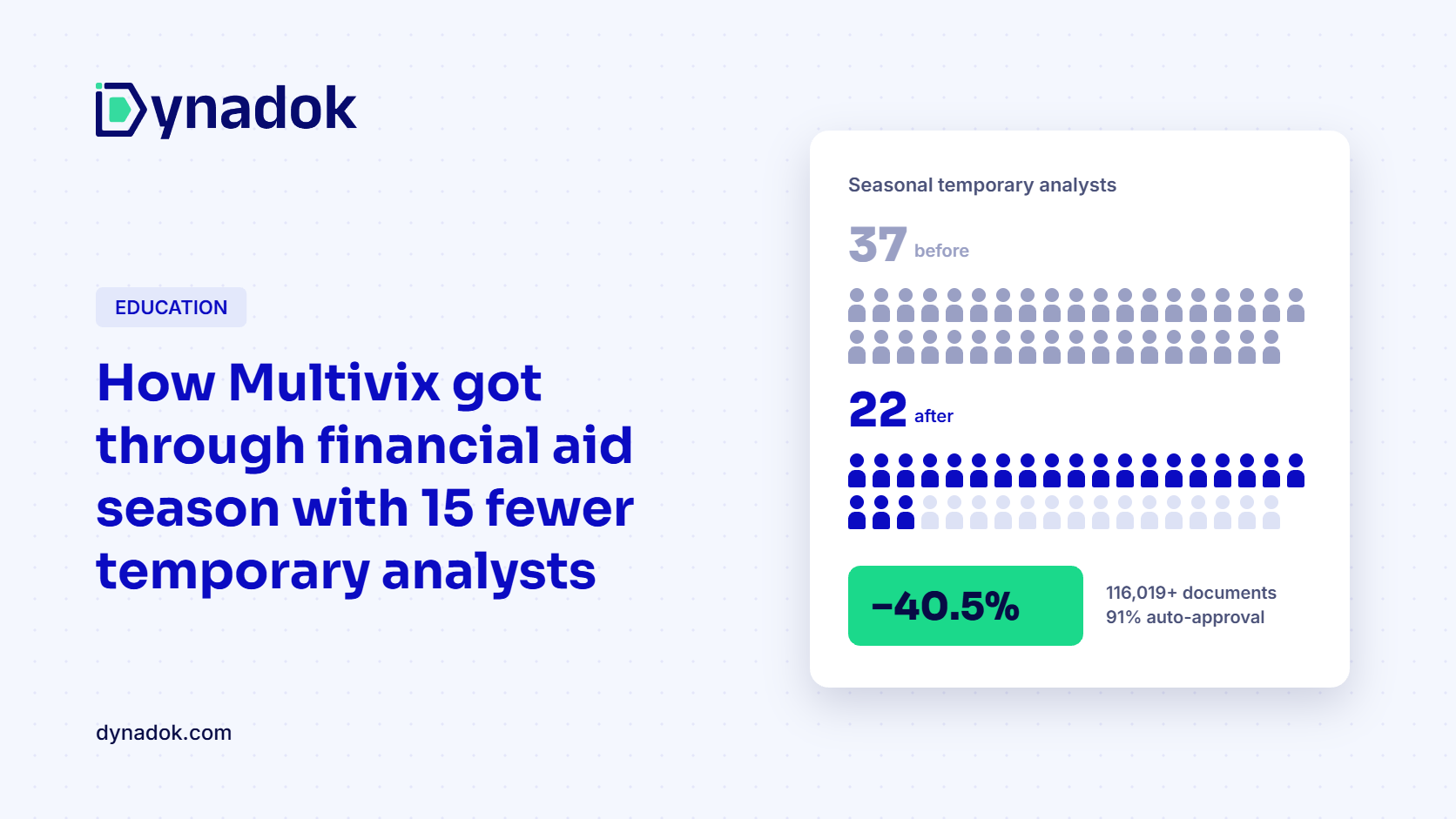
The project processed more than 5,372 applicants. It analyzed more than 116,019 documents. That is about 21 documents per applicant, on average.
Those documents added up to more than 342,007 pages. Roughly three pages per document.
That volume, concentrated in enrollment peaks, is what used to require temporary analysts.
What changed in the flow
The new process starts automatically. When a student enters the financial aid process, a webhook sends an invitation to a white-label portal.
The portal shows the document requirements for that student’s program.
The AI validates each document at upload. If a document is rejected, the student can correct it and resubmit it immediately.
Documents approved by the AI go to the back-office team. A person does the final verification and approval.
Students and staff track progress in real time. Potentially fraudulent documents are flagged for review.
Humans stayed in the loop
This is the part that matters for operations leaders. The AI did not replace the final decision.
The automatic approval rate reached 91%. Those approvals still went to a human for the final word. What changed is where people spend their time.
Before, staff opened emails, downloaded attachments and dealt with missing files. Now the first check happens at upload, and the team receives documents that already passed it.
Rules written in plain language
Four programs mean four sets of rules.
At Multivix, teams add custom rules by describing them to a generative AI assistant. The assistant writes the configuration scripts. One example from the project: consistency checks across different documents of the same applicant.
The project description names this as the main complexity. Turning business rules into reliable AI checks, including cross-document checks, without disrupting enrollment cycles.
Multivix’s IT and business teams configured the platform with support from Dynadok. The project ran from September 2025 to March 2026, with a scale of 1,100 human-hours. Alessandro Ventorin, CIO of Multivix, managed it on the customer side.
Fifteen fewer temporary analysts
Here is the staffing result.
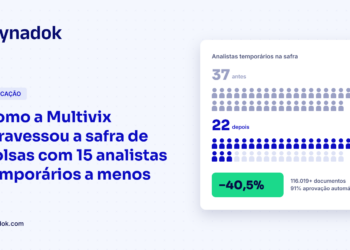
Seasonal temporary analysts went from 37 to 22. Fifteen fewer people. A 40.5% reduction.
The cost figures:
- Previous annual operating cost: US$ 75,652.
- First-year cost: US$ 40,812. Savings of US$ 34,840.
- Projected annual cost from year two: US$ 25,284.
- Projected recurring savings: US$ 50,368 per year, a 66% reduction.
The first-year savings is an estimate in the project data. The 66% is a projection from year two onward.
What other institutions can take from it
Three lessons stand out.
Fix the error at the source. The rework came from missing files, unreadable scans, lost emails and repeated rejections. At Multivix, validation now happens at upload, and rejected documents can be resubmitted immediately.
Keep the person for the decision. The AI handles the first check. A human still approves.
Plan capacity around the peak, not the average. At Multivix, the staffing result shows up in the season: 22 temporary analysts instead of 37.
For the full set of numbers, see the Multivix case study. For more on the programs involved, read our articles on ProUni document review and FIES document checks with AI (in Portuguese).
Prefer Portuguese? Read this article in Portuguese.
Source: project data published by Global CIO, Project of the Year 2026.
Use a calculadora de ROI da Dynadok: ajuste 3 dados da sua operação e veja, na hora, quanto a conferência manual custa hoje — e quanto volta ao seu caixa com a validação documental com IA.
Esses 3 dados descrevem como funciona a sua conferência de documentos hoje — é com eles que calculamos o custo atual da operação e a economia ao automatizar com IA. Não precisa ser exato: uma boa estimativa já gera um resultado confiável.
Considere o volume mensal de páginas que sua equipe precisa receber, organizar, conferir, validar e atualizar nos sistemas. Não sabe o total? Estime: documentos recebidos no mês × média de páginas por documento.
Processa 100 mil páginas ou mais por mês? Converse com um especialista para um plano sob medida.
Inclua o ciclo completo: abrir o documento, extrair dados, conferir regras, registrar o resultado e devolver pendências. Estudos de mercado apontam de 3 a 10 minutos por página — se nunca mediu, mantenha os 5 min, uma média conservadora.
Digite apenas o salário mensal de quem confere esses documentos hoje (ex.: analista, assistente administrativo), sem encargos. A calculadora acrescenta sozinha os encargos e benefícios, multiplicando por 1,7 — aproximadamente o custo real de um funcionário para a empresa.
O resultado é gerado depois do cálculo e atualizado sempre que você mudar os dados.
Você mudou os dados. Clique em Recalcular para atualizar o resultado.
Ajuste os dados da operação e clique em “Calcular minha economia” para ver uma prévia feita com os números do seu cenário.
Identificamos
alto potencial de economia
mais barato por mês que a operação manual
Estimativa de R$ 526.400 de volta ao seu caixa por ano
Preencha seus dados para ver a economia mensal em reais, o comparativo de custos e as horas liberadas na sua equipe.
Seus dados ficam seguros. Um especialista da Dynadok pode entrar em contato para ajudar na sua análise.
Economia anual estimada
Equivale a R$ 43.867 por mês
Estimativa conservadoraROI estimado (mensal)
A cada R$ 1 investido no plano, cerca de R$ 4,43 deixam de ser gastos na operação manual.
Redução do custo operacional
Você deixa de gastar cerca de 8 de cada 10 reais que o trabalho mecânico de conferência consome hoje.
Com um tempo médio de 5 minutos por página, um profissional valida cerca de 12 páginas por hora. Em uma jornada de 7 horas, são 84 páginas por dia — e, em 20 dias úteis, cerca de 1.680 páginas por mês. Como sua operação processa 20.000 páginas por mês, o volume equivale ao trabalho de aproximadamente 12 profissionais. Nesta avaliação, consideramos que cerca de 80% desse esforço é trabalho operacional mecânico — o equivalente a 10 profissionais e 1.333 horas por mês. São esses números que usamos em todo o resultado.
Com a Dynadok, todo o trabalho operacional — mecânico, repetitivo e manual — passa a ser feito pela IA. Isso libera cerca de 80% do time para outras frentes; os demais deixam a conferência página a página e passam a atuar apenas na validação final e no tratamento de exceções.
A redução de custo é só uma parte. Validar documentos com a IA da Dynadok também transforma a operação:
O que hoje leva horas passa a ser feito em minutos ou segundos, acelerando a resposta ao seu cliente.
Regras claras e validações automatizadas reduzem erros em tarefas repetitivas e não conformidades.
Valide grandes volumes, em qualquer formato ou layout, sem aumentar o time na mesma proporção.
Sua equipe sai das tarefas manuais e passa a cuidar de análises e decisões que fazem o negócio crescer.
Estimativa ilustrativa da calculadora de ROI. Jornada de 7 h/dia em 20 dias úteis (140 h/mês) por profissional e fator de provisão de 1,7 sobre o salário base. A economia compara o custo da mão de obra dedicada ao trabalho mecânico de conferência (cerca de 80% do esforço total; os demais profissionais seguem na validação final e em exceções) com o custo do plano Dynadok para o mesmo volume de páginas.
Gostou deste artigo?
Envie para quem também vai aproveitar este conteúdo.